Quitting Framework: When to Give Up?
This is the Quitting Framework I came up with to improve my decision-making process. It works for cases where there is some form of debt and the decision is about whether to continue spending resources in the future.
Example: “I want to continue working on the project because I’ve already invested so much into it.”
By “debt”, I mean you have some thought anchor attached to the project or commitment. You are upset because you spent a substantial amount of money, time, or energy. Or perhaps you have an internal anchor: an ego bruise, a desire to overcome a fear, or a need for redemption.
Important Prerequisite: If there is no debt, this framework does not apply.
The Quitting Framework Overview
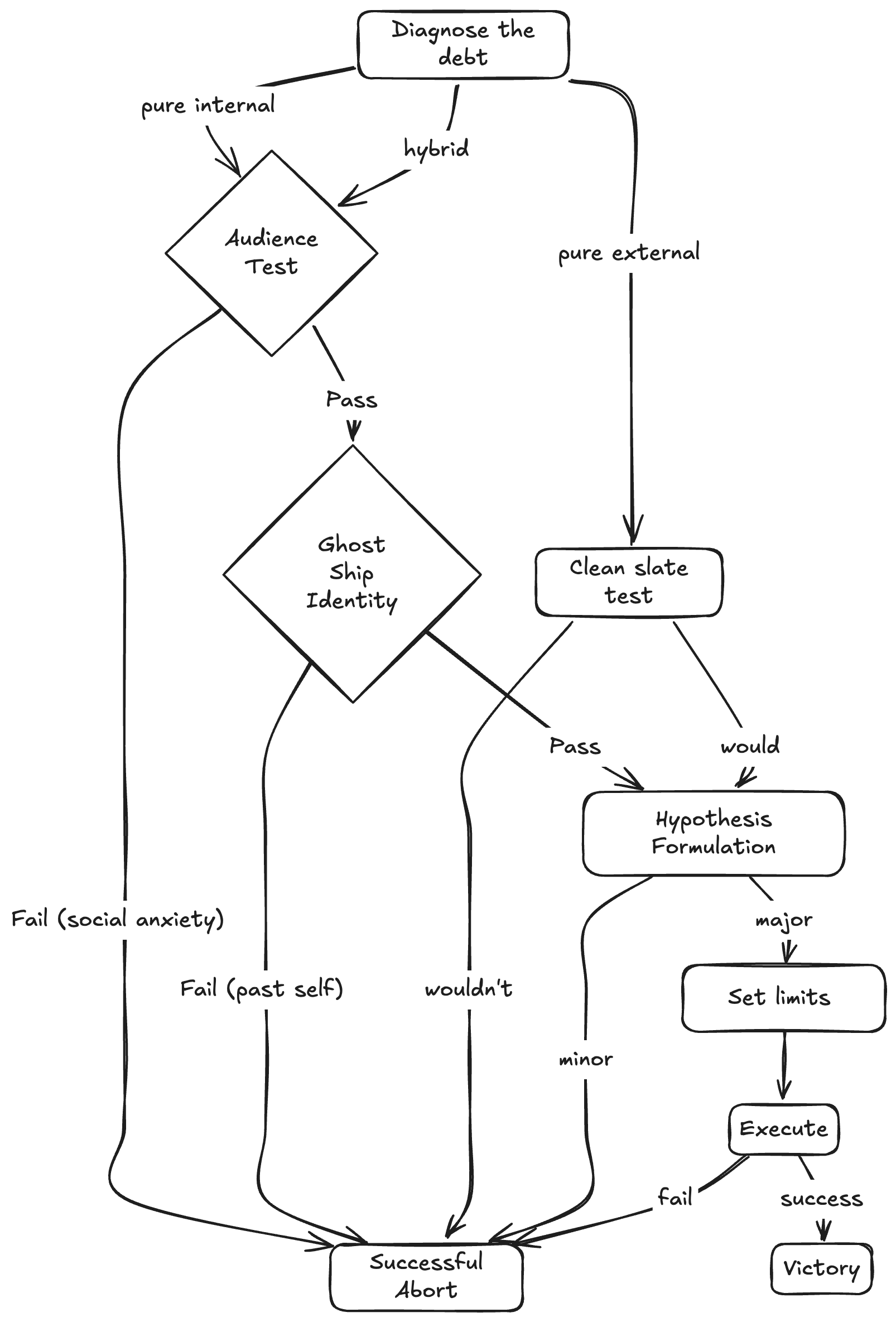
Step 1: Diagnose the Debt
I’ve categorized debt into 3 broad types. Let’s break them down one by one:
1. Pure External Debt
The simplest one. You’ve spent tangible resources on something and don’t want to accept losses. Humans are naturally biased towards the Sunk Cost Fallacy.
- The Money-Pit Car: You bought a car and it turned out to be faulty. It always needs repairs. You’ve already spent money buying it and fixing it. Now it needs even more repairs. You can either accept that you lost money and buy a new car, or keep repairing it forever.
- The Customer Service Loop: You returned plane tickets, but the refund hasn’t arrived. You talked to support, you talked to the carrier, sat through automated bots, and waited hours for operators. At some point, you realize it’s been a month. Is the remaining refund worth more than your ongoing time and sanity?
2. Pure Internal Debt
No meaningful physical resources were lost. The debt is entirely a fractured sense of self-trust or ego.
- The High Dive Retreat: You went to a community pool, climbed the ladder to the high dive, got paralyzed by fear, and had to do the “walk of shame” back down in front of everyone. The entire ordeal took three minutes and cost $0. But days later, you are still ruminating on it, feeling like a coward, and desperately wanting to go back and jump.
- The Crossed Boundary: You planned to tell your boss that you are no longer answering emails on weekends. You rehearsed the speech. But during the call, when asked to handle a Sunday project, you panicked, said “No problem,” and hung up. You are furious with yourself and feel like a pushover.
3. Hybrid Debt (External + Internal)
A combination of resource loss and personal identity/ego.
- The Failed Bar Exam: You spent three years and $120,000 on law school, but failed the state Bar exam twice. You are exhausted, broke, and want to quit, but your entire identity since childhood has been “the future lawyer.” Your family introduces you as “our daughter, who is going to be an attorney.”
- The Abandoned DIY Bathroom: To prove you are a “handy” homeowner, you gutted your master bathroom. Six months later, it’s still a construction zone. You’ve spent $3,000 on tools and tiles, but keep messing up the plumbing. You feel like a failure every time you brush your teeth in the hallway and want to spend another $1,000 just to prove you aren’t incompetent.
Step 2: Apply the Diagnostic Tests
Test 1: The Audience Test (Social vs. Internal)
Are you trying to restore self-trust, or are you trying to manage other people’s opinions of you?
Diagnostic Question: If you were the only person on Earth and nobody would ever know you failed, would you still care?
If NO: It’s not internal debt—it’s social anxiety. Walk away.
Test 2: The Ghost Ship Identity Test
Is this debt owed to who you used to be? We often hold onto goals simply because a past version of ourselves wanted them badly.
Diagnostic Question: Does this goal align with your Macro Goal today?
If NO: Abort.
Test 3: The Clean Slate Test
Imagine waking up today with a completely clean slate—zero history with the job, project, or relationship in question.
Diagnostic Question: Knowing everything you know right now, if you were starting from scratch today, would you choose to get into this?
Step 3: Formulate a Major Hypothesis
Define exactly what went wrong and what major change will fix it. You cannot simply “try harder.” Identify the specific gap that caused the failure and create a testable hypothesis:
Hypothesis Formula: “If I make [Major Change], then I will [Succeed].”
| Type | Example | Assessment |
|---|---|---|
| Valid (Major Hypothesis) | “If I completely stop coding and make 50 cold calls per week for a month, then I will get one paying client.” | 🟢 Focuses on a fundamental strategic shift. |
| Invalid (Minor Hypothesis) | “If I redesign the landing page, lower the price from $15 to $12, and fix three minor backend bugs, then people will buy.” | 🔴 Superficial tweaks. |
Red Flag Warning: If you find yourself dragged down by something—unable to progress and unable to quit—chances are you are gambling (testing micro-tweaks hoping for a different result).
Step 4: Set Limits & Define a “Successful Abort”
Set the price of closure before you begin. Prevent the endless “pivot trap” by capping the cost of redemption upfront with a strict boundary (e.g., “one more race,” “three more months,” or "$1,000").
Key Mindset Shift: Reframe hitting your limit not as a failure, but as a Successful Abort—a victory of your own discipline over irrational obsession.
Real-World Case Studies
Here is how the framework applies to actual situations from my life:
Case 1: The Endless SaaS Project
- Situation: I spent months making a personal SaaS project, pivoting multiple times. I added features and fixed bugs, but felt burned out and couldn’t find clients. Yet, I couldn’t stomach quitting because I had invested so many hours.
- Framework Analysis:
- Debt Type: Hybrid debt.
- Tests Passed: Passed both the Audience Test and Ghost Identity Test.
- Hypothesis Formulation: Formulated many minor hypotheses instead of quitting early. Eventually tried a couple of major hypotheses which failed.
- Outcome: I was gambling and losing time. Reached a point of burnout before finally walking away. Lesson: Should have set strict boundaries earlier.
Case 2: The 2 km Open Water Swimming Race
- Situation: After learning to swim at a beginner level, I entered a 1 km open water race for fun. I panicked after 50 meters and DNF’d (Did Not Finish). I felt deeply upset about giving up.
- Framework Analysis:
- Debt Type: Pure Internal debt (restoring self-trust).
- Tests Passed: Passed the Audience Test and Ghost Identity Test.
- Major Hypothesis: “If I hire a coach and train consistently for 6 months, I will be able to complete a 1-2 km open water race.”
- Strict Limit: “I will participate in races this summer. If I panic/fail in all of them, I walk away.”
- Outcome: Success! Trained hard and completed the Oceanman 2 km race. Victory!
Case 3: The Abandoned YouTube Channel
- Situation: I started a YouTube channel and made 3 videos. I realized I didn’t like how my voice sounded on camera and hated video editing. However, I was glad I tried it.
- Framework Analysis:
- Debt Type: None. I was content with having tried it out.
- Outcome: Because there was no debt, the framework didn’t even apply. I simply stopped without guilt.
FAQ: “What about ‘Never Give Up’?”
Distinguish between your Macro Goal and your Micro Vehicle:
- Macro Goal: “I want to be a successful entrepreneur.” → Never give up.
- Micro Vehicle: “I am trying to make this specific store or app profitable.” → Apply the Quitting Framework.